




This article is part of our NFL Draft series.
Fantasy football prospects to watch at the NFL Scouting Combine
This article identifies fantasy football targets in the 2026 NFL Draft rookie class with the most to prove or/and lose at the NFL Combine. Players report Feb. 22.
Many prospects decline to participate in some or all of the NFL Combine testing or/and positional drills, and the players listed here are not guaranteed to do anything other than the weigh-in. The players who do participate in the Combine provide the clearest possible signal on their objective athleticism, though, since its testing numbers are the most verifiable and neutral.
A good showing at the Combine means more than a good showing at a pro day, in other words, because pro day testing often features faster tracks or/and fast clock operators.
In a draft class that likely trends toward below average, it could be easier than ever for the top Combine performers to gain ground in the rankings.
The players are listed in general descending order of current fantasy ranking.
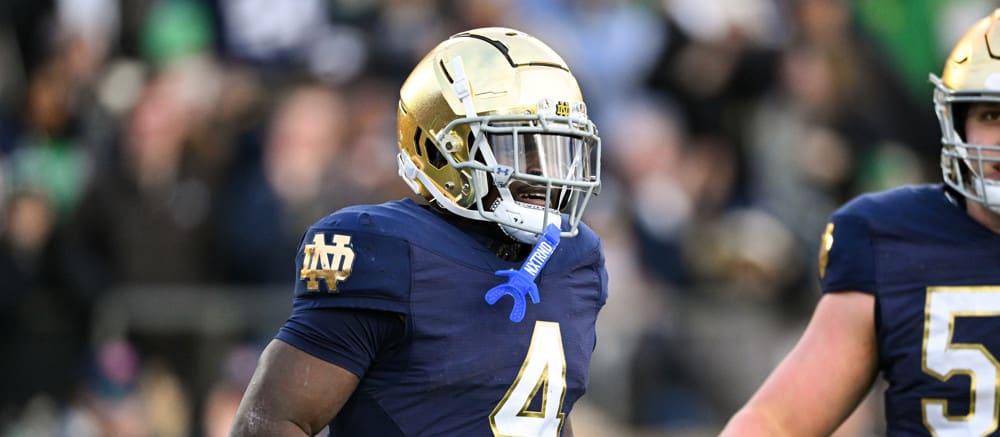
Jeremiyah Love, RB, Notre Dame (6-0, 214)
The big thing for Love is the weigh-in. Love's consistently blistering explosiveness at Notre Dame means we can probably take for granted that he's a clearly standout athlete, but the one concern in his profile is probably his height or/and the lean he runs with.
You generally want a running back to run with a stocky or hunched sort of lean since it makes them a smaller target and gives them better leverage against tacklers. Love might be a little upright instead, which if so would be a hit to his projections re: volume and between-the-tackles running. Indeed, at Notre Dame they did a good job of keeping Love's workload at a manageable level, exceeding 20 carries only three times in three years, all in the 2025 season.
Ideally, Love would weigh in with a height percentile lower than his weight percentile. If Love checks in at 6-foot-1 then that would register at 87th percentile among running backs, according to Mockdraftable. It might be asking a lot for Love to therefore log a weight of 87th percentile or higher in that scenario, but it would still be the ideal. Whatever his height percentile, we'd like the weight precentile to be equal or greater.
Whatever the eventual specifics, the farther Love's height/weight variable deviates from that equal-percentiles ideal the more concerning for Love's volume projection from scrimmage in the NFL. The worst-case scenarios that come to mind with this genre of Too Tall running backs are guys like Darren McFadden and Ryan Mathews, both of whom could run like crazy and were remarkable athletes yet had their NFL potential undercut by durability troubles.
If you want to make it as an upright, 6-foot-1 running back in the NFL then you'd ideally model yourself after 225-pounders like Deuce McAllister and DeMarco Murray. Although, both McAllister and Murray added 10-15 pounds following their Combine workouts.
Jordyn Tyson, WR, Arizona State (6-2, 200)
For Tyson to rank ahead of fellow first-round wideout candidates like Carnell Tate and Makai Lemon it will be important for Tyson's knee to check out well with Combine doctors after tearing the ACL, MCL and PCL in his eighth game as a true freshman.
Beyond that, Tyson also would ideally test well in the 40-yard dash, vertical jump and broad jump. 'Testing well' in Tyson's case is not as high of a bar as in some other cases, though. The plays where Tyson won in college generally did not require much speed to execute.
Dominant as he was in college, Tyson was more of an efficient workhorse than a true big-play threat. As long as he runs a 4.55 or better Tyson should be fine.
Nicholas Singleton, RB, Penn State (6-0, 221)
In this thin running back class there is a big opportunity for Singleton to seize if he can convince teams to look past his up-and-down production at Penn State. He can do that by logging standout athletic testing at the Combine, where the hope is that Singleton will run a 40-yard dash in the 4.40-second range or better at 220 or more pounds.
Singleton's rushing production lagged at times while Kaytron Allen's workload surged, but Singleton was the much better receiver. There aren't many 220-pound running backs with low-4.4 speed and the pass-catching ability Singleton has shown.
With that said, Singleton has more pressure on him than most players at the Combine because his sales pitch needs the standout speed component. If Singleton doesn't test well then it will hit his draft stock hard.
Jadarian Price, RB, Notre Dame (5-11, 210)
If Jeremiyah Love is Darren McFadden then that must mean Price is Felix Jones. Like Jones, Price was a college backup who might go in the first round anyway due to his big-play and kick-return ability.
Like the Singleton example, though, Price needs to run fast. If Price isn't fast then the Jones comparison is off, and at that point Price's prospect pitch would be seriously diminished. Anything worse than a mid-4.4 would be somewhat disappointing.
Aside from the athletic testing, it would be great for Price's draft stock if he could show well in pass-catching drills. He basically never caught passes at Notre Dame, but it remains to be seen whether that was by incidental design or if Price for some reason couldn't handle the task.
Ted Hurst, WR, Georgia State (6-3, 207)
Would you be interested in another Nico Collins type, perhaps? Hurst could establish himself as that sort of prospect with good enough athletic testing.
Not that Hurst needs to torch the Combine or anything – he can project as an NFL starter without demonstrating raw downfield speed – but if Hurst can break the 4.50 mark in the 40 he really might present a similar vertical boundary threat to Collins.
Hurst drew an extremely high target rate in college for a player operating from the boundary and downfield – two variables that tend to be a downward pressure on per-snap target rate – and if he has enough raw speed to work with he could keep winning the same way in the NFL. If Hurst's speed trends more toward average, though, he would probably need to make it work in the NFL without winning downfield quite as often as he did in college.
Eli Stowers, TE, Vanderbilt (6-4, 235)
Kenyon Sadiq, TE, Oregon (6-3, 235)
Justin Joly, TE, North Carolina State (6-3, 251)
Tanner Koziol, TE, Houston (6-7, 245)
John Michael Gyllenborg, TE, Wyoming (6-5, 251)
Tight end personnel is in greater demand than ever. NFL front offices and coaches at large won't be able to resist the copy-cat temptation following a season where most of the best offenses (Buffalo, Seattle, the Rams, etc.) ran extremely heavy tight end and fullback personnel. Not just that, but the 2025 rookie tight end class will go down as one of the best ever, and teams that didn't get one last year will be feeling left out going into the 2026 draft.
This is all to say there is a great deal of opportunity awaiting the 2026 tight end class in general. Each of these five tight ends is a candidate to land in Day 2 or better with sufficient athletic testing, making them the main fantasy factors to watch at tight end in this draft.
Eli Stowers is a former standout quarterback recruit who flopped at Texas A&M before moving to tight end. Stowers played tight end for New Mexico State (2023) and Vanderbilt (2024-2025). It sure seems like Stowers moved to the right position – he looks totally natural as a route runner, pass catcher and runner after the catch. He's light, though, so Stowers would ideally test well athletically so NFL teams can buy in on Stowers as a volume pass-catching candidate.
Kenyon Sadiq is in a similar boat as Stowers at around 235 pounds, though Sadiq is younger and might have more upside than Stowers. A strong showing at the Combine would go a long way toward Sadiq making his case to be the first tight end selected.
Justin Joly is another one of the standout pass-catching tight ends in this draft. Joly drew targets at a very high rate at Connecticut before playing a more balanced role at North Carolina State the last two years, logging more blocking reps than he did at UConn. Joly's production says he almost definitely has the skill set to produce as a pass catcher in the NFL, so now we wait to see if he can demonstrate the athletic traits necessary for that skill set to materialize at the next level.
Tanner Koziol is probably too thin to take inline reps on more than an occasional basis, so it's important that he demonstrates the athletic ability necessary to draw and convert targets in the NFL. Koziol certainly drew targets at a rapid rate in college, at both Ball State and Houston, so he could pose significant fantasy upside if he shows the wheels and hops to keep drawing targets with the jump in competition.
John Michael Gyllenborg will need to answer durability questions in addition to the athletic testing, so he might have a little more working against him than the previous four tight ends. With that said, if Michael Gyllenborg's durability issues are not an ongoing concern then there's reason to suspect he'll otherwise demonstrate the athleticism necessary to project as a potential starting tight end in the NFL. Michael Gyllenborg made an unusual number of big plays downfield at Wyoming, so the wheels might be there.
Although they weren't featured here, it's also worth keeping an eye on Combine invite tight ends like Max Klare (Ohio State), Dallen Bentley (Utah), Dae'Quan Wright(Mississippi), Michael Trigg (Baylor), RJ Maryland (SMU) and others.