




This article is part of our Best Ball Strategy series.
NFL Best Ball Fantasy Football: Wide Receiver Analysis and Early 2026 Best Ball ADP
We'll keep things rolling with our position-by-position primers for NFL Best Ball with a look at the receivers. I'm going to dig into the historical best ball data to identify some key markers for WR draft strategy. I'll take a deeper dive into what fueled the breakout seasons from the best late-round receivers last year, like Michael Wilson and Parker Washington, and apply that to this year's ADP to find some potential endgame steals. And at the end, I'll break down my top 15 receivers for 2026 compared to the early ADP.
It's only February but best ball season is already here! Be sure to bookmark our best ball cheat sheet for 2026 with custom rankings for each major best ball platform.
Optimal Ranges to Draft WR in Best Ball
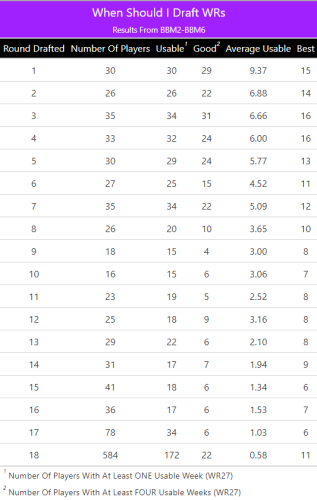
This table breaks down when wide receivers were taken in Underdog best ball drafts from 2021-2025 and the average amount of "usable weeks" a receiver taken in a given round would return. We define usable as finishing as WR27 or better in a given week. If a wideout gives you four usable weeks, we call that "good." Fancy terminology, I know.
It's pretty remarkable how stable the top of the receiver position has been year over year. On average, a receiver taken in the first round of best ball drafts has returned 9.37 usable weeks during the fantasy regular season.
That's 2.34 more usable weeks than what first-round running backs have produced on average. The bar's a little higher for a running back (RB18), but there's reason to believe that the receivers available to you in the first round are going to give you a really strong starting point to your roster.
What's interesting is the dropoff severity from Round 1 to Round 2 for receivers compared to RBs. For receivers, the average usable weeks variable drops from 9.3 to 6.8. For running backs, it only drops from 7.04 to 6.46.
The usable average stays pretty flat from the third round through the seventh rounds before tapering off to where you're aiming for about three usable weeks from each receiver you take from there on.

Late Round Receivers
We're inherently going to have a harder time finding diamonds in the rough in the late rounds. The best ball market is mostly efficient, so the best players are generally off the board by the time we get to the 14th round or so. There are, of course, guys that slip through the cracks.
Late-round receivers are more efficient picks than late-round running backs. With running backs, the 15th round is essentially the last round where you can expect even one usable week. Round 16-18 RBs produce less than one usable week on average.
Receivers, meanwhile, fare a bit better. It checks out. Receivers have fewer barriers to fantasy production than RBs do. Most teams have at least three receivers on the field for the majority of their plays. According to Sumersports, only nine teams ran 11 personnel (1 RB, 1 TE, 3 WR) fewer than 50% of the time.
That doesn't mean all late-round receivers are created equal. Chasing a player with a decent snap projection is a fine enough starting point, but we want some actual involvement beyond just being on the field. Some guys have decoy functions (high snap count, low target/route run).
Targets per route run isn't the be-all, end-all fantasy stat, but it's a nice metric that can help you identify some potential breakouts.
Here's a visual of late-round wideouts (ADP >180). We take TPRR% on the x-axis and fantasy points on the y-axis. We then sized and color-coded each of these players. The bigger the bubble, the more targets he had.
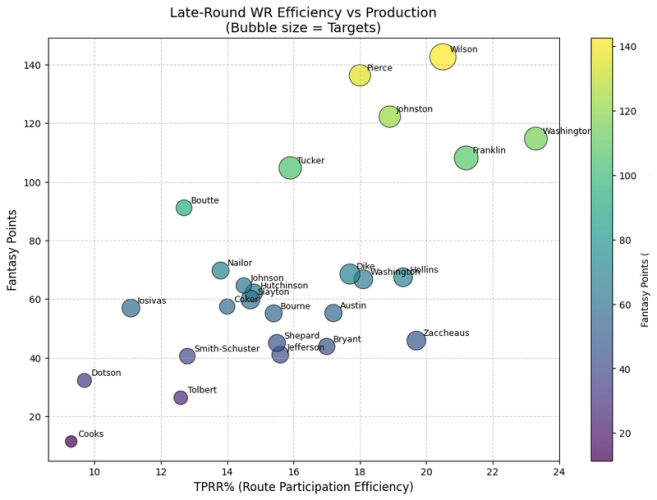
Here is a corresponding table of players with ADPs between 180 and 215 in 2025, sorted by TPRR%.
| Name | Team (ADP) | Underdog ADP | TPRR% | Targets | Fantasy Points |
|---|---|---|---|---|---|
| Parker Washington | JAX | 215.9 | 23.3 | 96 | 114.7 |
| Troy Franklin | DEN | 186.5 | 21.2 | 104 | 108.1 |
| Michael Wilson | ARI | 195.1 | 20.5 | 126 | 142.6 |
| Olamide Zaccheaus | CHI | 215.3 | 19.7 | 65 | 45.8 |
| Mack Hollins | NE | 216 | 19.3 | 65 | 67.4 |
| Quentin Johnston | LAC | 192.9 | 18.9 | 84 | 122.2 |
| Malik Washington | MIA | 198.5 | 18.1 | 65 | 66.7 |
| Alec Pierce | IND | 205.6 | 18 | 84 | 136.3 |
| Chimere Dike | TEN | 215.9 | 17.7 | 74 | 68.5 |
| Calvin Austin | PIT | 214.3 | 17.2 | 55 | 55.2 |
| Pat Bryant | DEN | 185.7 | 17 | 49 | 43.8 |
| Tre Tucker | LV | 215 | 15.9 | 92 | 104.7 |
| Van Jefferson | TEN | 216 | 15.6 | 52 | 41 |
| Sterling Shepard | TB | 216 | 15.5 | 53 | 45 |
| Kendrick Bourne | SF | 216 | 15.4 | 53 | 55.1 |
| Xavier Hutchinson | HOU | 216 | 14.8 | 57 | 62.1 |
| Darius Slayton | NYG | 190.3 | 14.7 | 64 | 59.8 |
| Tez Johnson | TB | 215.9 | 14.5 | 44 | 64.6 |
| Jalen Coker | CAR | 184.1 | 14 | 43 | 57.4 |
| Jalen Nailor | MIN | 215.8 | 13.8 | 53 | 69.7 |
| JuJu Smith-Schuster | KC | 215.7 | 12.8 | 45 | 40.5 |
| Kayshon Boutte | NE | 214.8 | 12.7 | 46 | 91.1 |
| Jalen Tolbert | DAL | 215.6 | 12.6 | 34 | 26.3 |
| Andrei Iosivas | CIN | 206.2 | 11.1 | 58 | 56.9 |
| Jahan Dotson | PHI | 215.7 | 9.7 | 36 | 32.2 |
| Brandin Cooks | BUF | 216 | 9.3 | 25 | 11.4 |
Let's look at the five best receivers by fantasy points from last year's late-round bucket.
- Michael Wilson: This was an all-timer of a season from Wilson in terms of production, timing of production, and acquisition cost. Wilson was a 16th-rounder for good reason. Trey McBride was already a target hog, and the market believed in a Marvin Harrison breakout. Wilson had been efficient with his opportunities through two years (8.6 YPT, 66% catch rate, aDOT >12 Yards), but the market figured there wouldn't be enough targets to make him useful. His TPRR% was 14.6% or worse in his first two seasons. A 20.6% TPRR couldn't be predicted. There was, however, reason to believe Wilson could have been solid on a per-target basis and play upwards of 800 snaps.
- Alec Pierce: I was belligerently in on Pierce last week to the tune of 20% exposure rate last year. I was always intrigued by the size/speed combo and felt like even though he'd never be a target monster with Michael Pittman and Josh Downs there, Pierce would make his opportunities count as well as anyone in the later rounds. His target percentage didn't really increase that much this year (14.2➡️16.0), and neither did his catch rate. What stood out was that Pierce had a crazy aDOT with a skill set that warranted that type of target depth. He dominated air yardage in 2024 and did so again in 2025. Basically, there were clues that Pierce could be a really good pick, even with some week-to-week volatility in his profile. Prime example of a "better in best ball" skill set.
- Quentin Johnston: Ah, the proverbial "former first-rounder."
Johnston actually had a solid 2024 with 711 yards and eight touchdowns on 91 targets, but the market effectively wrote him off. In fairness, the Chargers' offseason signaled that they were getting ready to write him off, too. They brought in Keenan Allen and spent a Day 2 draft pick on Tre' Harris. That was in addition to the market viewing Ladd McConkey as a strong second-round pick in drafts. It was reasonable to think Johnston's 91 targets and eight scores would regress.
In the end, it was McConkey who regressed, and Johnston managed to keep his production afloat.
- Parker Washington: Washington was another late-round candidate who had flashed some talent in limited opportunities previously, but seemed to be blocked from getting any sort of reliable usage. The Jaguars seemingly had a locked-in WR1 in Brian Thomas and spent the second overall pick on Travis Hunter. Even if Hunter's offense vs defense split was a heated debate all summer, it didn't seem like there was a clear path for Washington to thrive.
Washington's breakout was almost like having a 10-leg parlay hit. He needed BTJ and Hunter to have the type of seasons that they did. He needed Jakobi Meyers' inclusion into the offense to not negatively impact his role. And he needed Trevor Lawrence to take a massive leap. It was a perfect storm. A season like his doesn't happen every year. - Troy Franklin (ADP 186, WR30): Franklin was a classic Year 2 breakout. His rookie year didn't really give us much of a foreshadowing, so taking Franklin in 2025 was essentially an endgame dart throw. 2024 had a concerning catch rate and drop rate, but Franklin did grade well on TPRR% (19.7%). You could have identified that there were a ton of snaps up for grabs in this offense outside of Courtland Sutton. And you could have noted that he draws a strong volume of targets on his snaps. Boosted playing time while maintaining a strong TPRR% figure allowed Franklin to become one of the best late-round picks from last year.
The problem is that none of these guys who rated well by these metrics will be as cheap in drafts this year. It's hard to call which fringe guys will ultimately command a strong target share on their routes. However, we have to try because getting these types of picks into our portfolio provides a significant edge.
2026 Late Round Receivers
Let's look at the new Underdog ADP and dig into the late WR options.
| Player | 2026 ADP | positionRank | Team | TPRR% | Targets | Fantasy_Pts | aDOT |
|---|---|---|---|---|---|---|---|
| Chimere Dike | 174.9 | WR73 | Tennessee Titans | 17.7 | 74 | 68.5 | 8.7 |
| Tre Tucker | 181.6 | WR75 | Las Vegas Raiders | 15.9 | 92 | 104.7 | 10 |
| Tre' Harris | 182.4 | WR76 | Los Angeles Chargers | 16.2 | 43 | 39.4 | 8.4 |
| Tory Horton | 191.7 | WR77 | Seattle Seahawks | 18.1 | 23 | 46.1 | 14 |
| Elic Ayomanor | 194 | WR78 | Tennessee Titans | 19.4 | 89 | 75.5 | 11.3 |
| Ja'Kobi Lane | 195.6 | WR79 | — | — | — | — | |
| Keon Coleman | 201.2 | WR80 | Buffalo Bills | 19.4 | 59 | 64.4 | 11.2 |
| Zachariah Branch | 201.6 | WR81 | — | — | — | — | |
| Marvin Mims Jr. | 202.4 | WR82 | Denver Broncos | 18.1 | 51 | 51.8 | 9.2 |
| Kyle Williams | 209.1 | WR83 | New England Patriots | 12.3 | 21 | 38.9 | 18.7 |
| Darnell Mooney | 212.3 | WR84 | Atlanta Falcons | 16.4 | 72 | 50.3 | 14.1 |
| Ryan Flournoy | 213.2 | WR85 | Dallas Cowboys | 20.6 | 56 | 74.0 | 9.1 |
| Devaughn Vele | 215.8 | WR86 | New Orleans Saints | 17.2 | 40 | 41.3 | 10.9 |
| Omar Cooper Jr. | 217.6 | WR87 | — | — | — | — | |
| Chris Brazzell II | 221.9 | WR88 | — | — | — | — | |
| Chris Bell | 221.9 | WR89 | — | — | — | — | |
| Cooper Kupp | 226.1 | WR90 | Seattle Seahawks | 17.7 | 70 | 71.3 | 8.0 |
| Jaylin Noel | 228.6 | WR91 | Houston Texans | 17.1 | 35 | 42.7 | 9.5 |
| Rashod Bateman | 228.7 | WR92 | Baltimore Ravens | 12.4 | 39 | 34.4 | 11.4 |
This is where player evaluation and team context come into play for best ball drafters. We have to ask ourselves, "who is this guy, and where does he fit in his offense?"
Chimere Dike (WR73) & Elic Ayomanor (WR78)
I wouldn't be surprised to see some consensus optimism around Tennessee's offense as the offseason unfolds. It's Year 2 for these guys and Cam Ward, plus Brian Daboll is coming in to take over the offense. Even in brutal conditions this past season, Dike and Ayomanor had promising rookie years.
Dike's numbers were solid, especially for a Day 3 rookie, and his role should expand in Year 2. He didn't start seeing full snap shares until around mid-way through 2025 and he still managed strong marks in YAC and TPRR%. Dike could be a high-volume slot option and with his 4.34 speed, there's big-play potential in his profile as well. His open-field abilities were already plenty on display in the return game this past year.

Ayomanor goes a bit later than Dike and is equally deserving of being on your radar. While he didn't rate well in some areas -- a 46% catch rate is admittedly bad, as is a 5.8 YPT on 89 targets -- there are elements to Ayomanor's profile that are promising. He has a downfield role (12.1 aDot) and skill set, and he commanded a high percentage of the team's air yards (28.4%, 84th percentile) while also maintaining a strong TPRR% (19.4).
Even modest improvements to Ayomanor's catch rate would set him up to massively outproduce his current ADP.
The risk with going too heavy at either of these Titans' wide receivers is that the franchise could have one of the most active offseasons in the league. They're going to be motivated to maximize the supporting cast around last year's No.1 overall pick in Ward, and they have the means to do it.
Tennessee has the most cap space in the league by a decent margin and can drop the fiscal hammer to make some splash signings this spring. The free agent class is headlined by the likes of George Pickens, Deebo Samuel, Jauan Jennings, Alec Pierce and others. It would be wild for the Titans to eschew upgrading their receiver room in free agency.
Still, there's enough in both Dike and Ayomanor's profiles to make them worthwhile late-round targets for now.
Ryan Flournoy (WR85, ADP 212)
The Cowboys have found something in Flournoy, a 2024 6th-rounder. There's reason to believe he can have a role in this offense even if they bring back George Pickens in free agency. Flournoy produced 40 catches for 475 yards on 56 targets this past season and had a strong 20.6 TPRR%. Drawing that level of target concentration with that level of competition around him is a mark in his favor.
Flo also has legitimate starter athleticism with 4.44 speed, a 39.5-inch vertical and a 132-inch broad jump. If the Cowboys can't pony up what it takes for Pickens -- which is possible given their cap situation -- Flournoy could be on the ascent. He is better than the rest of the Cowboys' alternatives like Jalen Tolbert, KaVontae Turpin, Jonathan Mingo etc.
As it stands, you could be getting a starting receiver in one of the league's most pass-happy offenses for next to nothing by snagging Flournoy at his current ADP.
Best Late Round WR Seasons 2021-2025
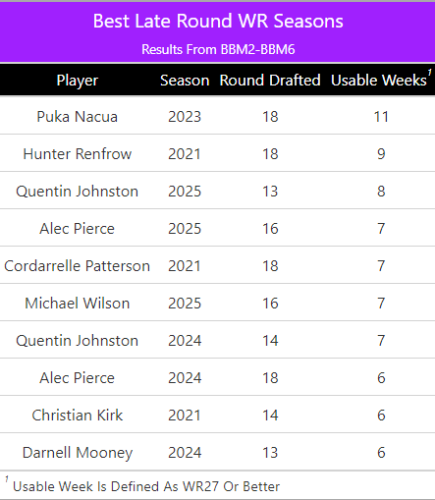
Best 2025 WRs by Round
| Round | Name | Team | ADP | Fantasy Points |
|---|---|---|---|---|
| 1 | Amon-Ra St. Brown | DET | 10.05 | 207 |
| 2 | Puka Nacua | LAR | 13.25 | 248 |
| 3 | Jaxon Smith-Njigba | SEA | 32.65 | 242.9 |
| 4 | Davante Adams | LAR | 44.25 | 162.9 |
| 5 | George Pickens | DAL | 51.95 | 196.9 |
| 6 | Zay Flowers | BAL | 62 | 163.3 |
| 7 | Chris Olave | NO | 74.45 | 170 |
| 8 | Jauan Jennings | SF | 94.2 | 118.3 |
| 9 | Michael Pittman | IND | 100.1 | 120.4 |
| 10 | Jayden Higgins | HOU | 110.3 | 88.5 |
| 11 | Keenan Allen | LAC | 130.15 | 101.7 |
| 12 | Luther Burden | CHI | 134.85 | 80.9 |
| 13 | Joshua Palmer | BUF | 153.95 | 30.3 |
| 14 | Hollywood Brown | KC | 167.8 | 88.7 |
| 15 | Romeo Doubs | GB | 177.45 | 108.4 |
| 16 | Troy Franklin | DEN | 186.5 | 108.1 |
| 17 | Michael Wilson | ARI | 195.1 | 142.6 |
| 18 | Alec Pierce | IND | 205.6 | 136.3 |
2026 Wide Receiver Rankings
Below are my 2026 wide receiver rankings (Y-axis) and the Underdog ADP rankings (X-axis)

You're not going to find a ton of major disagreements among the top, but obviously there are some differences. These picks are higher leverage for your drafts so getting them right is extremely important. You don't want to be left holding this year's Justin Jefferson when you could have had this year's Puka Nacua, for instance. Here are some quick hitters on this year's group.
- Ja'Marr Chase (My Rank: WR1; UD ADP Rank: WR2) Chase is still the best receiver in football in my opinion. Joe Burrow's lengthy injury history is a concern when it comes to Chase maximizing his talent, sure, but if things break right in that regard, there's a chance of a historic fantasy season from Ja'Marr. That's what I'm after.
- Drake London(My Rank: WR4; UD ADP Rank: WR8) I seem to be a little ahead of market on London, having him as my WR4 while the ADP has him more like WR8. I'm bullish on Atlanta's offense this year, generally, and I still think there's another level to London's game that we haven't seen just yet. He has blue-chip marks in TPRR% (30.7%) and YPRR (2.52, 96th percentile). I think London has at least one top 5 WR season in his future, and with a better offensive scheme incoming, I think it could be this year. That would be good timing with it being the last year of his rookie deal...
- Rashee Rice (My Rank: WR23; UD ADP Rank: WR11): I don't know what I'm missing here, but if I'm going to need to take Rice at the 2-3 turn, it's going to be a low-carb draft season for me. I'm worried about this offense even when Mahomes returns. It was a clunky outfit even before he got hurt this past season. Taking Rice this early with contextual concerns, along with the fact that we're two years removed from his only truly useful fantasy season, gives me a lot of pause. I'll concede that he should get fed, assuming he's healthy and available all season. His 26.4 overall ADP seems to be brushing aside a lot of potential issues for Rice this year and instead feels like you're paying close to the ceiling case.
- Justin Jefferson (My Rank: WR10; UD ADP Rank: WR6): JJettas is one of the best receivers I've seen in my lifetime. I don't know how you can feel good about him as WR6 this year after what we saw in 2025. The Vikings seem to be a mess at QB; you're either going to need a massive leap out of J.J. McCarthy or some last-stand heroics from Kirk Cousins to salvage this passing game and Jefferson's fantasy value. Too much can go wrong here for me to have JJ at WR6, which necessitates taking him around the 1-2 turn. There's seemingly a collective amnesia for what was a WR25 season from Jefferson last year.
- Zay Flowers (My Rank: WR13; UD ADP Rank: WR20): While Jefferson isn't getting dinged at all for a tough 2025, Flowers is getting next to no credit for finishing as WR7 in half-PPR formats. He's locked into a huge target share with an MVP-caliber quarterback running the show. Flowers' frame prevents him from having a big red zone role, which is important in half PPR formats, but he still managed a top 10 season with only 5 TDs last season. He's going to push for 120 targets, he's going to catch a high percentage of them, and he's going to do some damage with those receptions. I'll happily draft him in the mid 40s if that's where the market says he should go.