






This article is part of our NFL Offseason Research series.
The weekly fantasy football offseason notes article is designed to keep you plugged into my thought process throughout the NFL offseason. Each week, I'll focus on developments that matter most for fantasy football, with an emphasis on projecting offensive environments before the market fully adjusts.
This week, we'll look at the most impactful statistics from the last season and how they may be misleading for fantasy managers preparing for the season. Be sure to check out the 2026 RotoWire fantasy football projections to see how we feel that players on these teams will perform.
 Dalton Kincaid, TE, Buffalo Bills
Kincaid's per-game production quietly improved in 2025. He averaged 47.6 receiving yards per game, up from 34.5 in 2024 and 42.1 as a rookie in 2023. His five touchdowns were also a career high. On the surface, that's steady growth.
The concern is availability. Kincaid has now missed nine games in the last two seasons, and in both years he saw limited snaps late in the season while working back from injury. That trend is a red flag, even though he did play 16 games as a rookie. Consecutive injury-affected seasons don't guarantee future absences, but lack of durability is now part of his profile.
When Kincaid is on the field, Josh Allen looks for him constantly. He was targeted on 33.3 percent of his routes run, an elite rate that shows how central he is to the passing design. His 11.7 yards per target reflects strong per-target efficiency, and his two 100-yard games showed a ceiling that few tight ends can match.
The bigger question is volume. Buffalo remains a run-heavy team, especially in the red zone. If the Bills add perimeter receiving talent, Kincaid's weekly targets could tighten even further. A realistic 2026 projection, assuming 15-plus games, lands somewhere in the range of 55-70 catches, 700-850 yards and 5-7 touchdowns.
He's unlikely to see the elite volume of the top-tier tight ends, but drafting him outside the top 100 and pairing him with another mid-round option is a viable strategy. Used properly and when healthy, Kincaid can deliver low-end TE1 production.
Khalil Shakir, WR, Buffalo Bills
After breaking out in 2024 as Josh Allen's most trusted wide receiver, Shakir essentially repeated that production in 2025 on slightly fewer targets. His yards per reception dipped from 10.8 to 10.0, but his role remained stable. Most important, he did not miss a game due to injury.
Shakir's season was steady but unspectacular. He played just 57 percent of offensive snaps and exceeded a 70 percent snap share only once. That limited playing time caps his ceiling. He posted eight double-digit PPR games but also delivered four outings under seven points. Despite solid target volume, he wasn't a consistent WR2.
He operates almost exclusively from the slot as a short-area separator. That role provides a somewhat stable floor but limits explosive plays and red-zone dominance. Buffalo scored 30 rushing touchdowns as a team, reinforcing how difficult it is for any receiver to post elite touchdown numbers in this offense.
Shakir's 719 receiving yards led all Bills wide receivers, which says as much about the state of the room as it does about his role. If Buffalo adds outside talent, he could lose a few targets, but his chemistry with Allen and slot role appear secure.
There's little reason to expect dramatic expansion or decline in his usage. At about pick 115, Shakir makes sense for managers building rosters around volatility elsewhere. In a draft range often filled with pure lottery tickets, he offers a decent floor.
 Rico Dowdle, RB, Carolina Panthers/Free Agent
Dowdle finally played a full 17-game season in 2025, an encouraging development given his injury history dating to college. However, his production was heavily skewed by two explosive weeks when Chuba Hubbard was sidelined.
In Weeks 5 and 6, Dowdle posted 445 rushing yards and two touchdowns on 55 carries, scoring more than 30 PPR points in both games. That stretch was electric, and likely unrepeatable, especially considering both opposing run defenses were struggling at the time.
In his other 15 games, Dowdle averaged just 42 rushing yards and 4.2 yards per carry. As a PPR back, he produced roughly 10.6 points per game in that span. His late-season fade was especially concerning. From Week 12 onward, including the playoffs, he averaged 37.4 rushing yards and just 3.3 yards per carry. He finished with less than 60 rushing yards in seven consecutive games and managed only five carries for nine yards in the wild-card loss.
His 3.0 yards after contact is mediocre for a lead back, suggesting limited creation ability once blocking breaks down.
Still, Dowdle showed in 2024 with Dallas and during parts of 2025 that he can handle volume when given the opportunity. If he lands in a situation with a strong offensive line and a clear lead role, he has RB2 potential. Available outside the top 100 picks, he's defensible at cost, but the late-season decline makes him someone I won't aggressively target.
Chuba Hubbard, RB, Carolina Panthers
Hubbard's decline from 2024 to 2025 was dramatic. After posting 1,195 rushing yards in 2024, he fell to just 511 yards on 134 carries in 2025. His 3.8 yards per carry was a career low, and his lone rushing touchdown resulted in an abysmal 0.7 percent touchdown rate.
His first four weeks were respectable, averaging 4.1 yards per carry. Then came the Week 5 calf injury. After returning in Week 7, his role steadily diminished. By Week 9, Rico Dowdle had been declared the lead back.
From that point, Hubbard averaged little more than six carries per game. His underlying metrics paint the picture of a back who lacked explosiveness. A modest broken tackle rate and just 2.2 yards after contact suggest he wasn't creating much beyond what was blocked.
If Dowdle leaves in free agency and Hubbard reclaims the lead role, volume alone could restore RB2 value in a run-focused offense. He's entering the third year of a four-year contract that pays him like a starter, which matters for organizational commitment.
At about pick 90, Hubbard works as a dart for managers who wait on running back and need potential volume plays. His 2024 season was likely his ceiling, but in fantasy football, opportunity often outweighs efficiency.
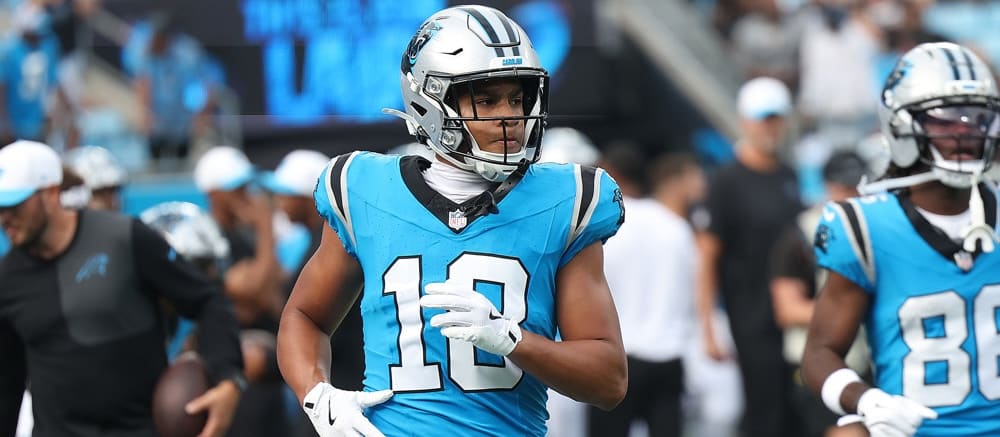
Jalen Coker, WR, Carolina Panthers
Tetairoa McMillan profiles as Carolina's alpha receiver, but Coker looks like the player Bryce Young trusts most in key situations.
Coker's season was defined by his delayed start. He did not play in Weeks 1-6. After a quiet return in Week 7, he broke out in Week 8 and remained productive through Week 16. His playoff performance — nine catches for 134 yards and a touchdown — was the best game of his career and showcased legitimate upside.
He caught 76.7 percent of his targets and did not record a drop, an elite reliability mark. When the ball came his way, he converted.
Durability remains the primary concern. He has played in 22 of 34 games the last two seasons. That 65 percent availability rate significantly impacts his profile.
Still, even within one of the league's weaker passing attacks, Coker has the talent to finish inside the top-40 receivers in PPR formats if he stays healthy. In early best ball drafts, he's going around pick 117. At that price, the injury risk becomes easier to tolerate. I'll be looking to add Coker anytime after pick 100.
Conclusion
As you continue preparing for 2026, make sure to reference the RotoWire Fantasy Football Depth Charts to track evolving roles and roster changes as teams finalize their lineups. And don't miss any of my offseason articles — be sure to visit my article page for weekly updates, strategy insights and early fantasy takes throughout the NFL offseason.