






This article is part of our Farm Futures series.
The top 400 prospect rankings are fully updated, as are the First-Year Player Draft rankings and the FYPD Blueprint. It's dynasty baseball season, but it's also heading into the heart of redraft fantasy baseball season, so I wanted to release an updated version of my top rookies to target in 2026 leagues.
I've noted each prospect's ADP from the last 15 NFBC Draft Champions leagues, and at the bottom of the article, there is a table showing where each prospect's ADP was through the first 12 Draft Champions vs. where it has been recently. I've marked UP or DOWN for prospects I'm higher or lower on than I was on version 1.0 and version 2.0 this offseason. I've also written the outlooks for hundreds of prospects, if you want a more in-depth breakdown of any of the players mentioned in this article.
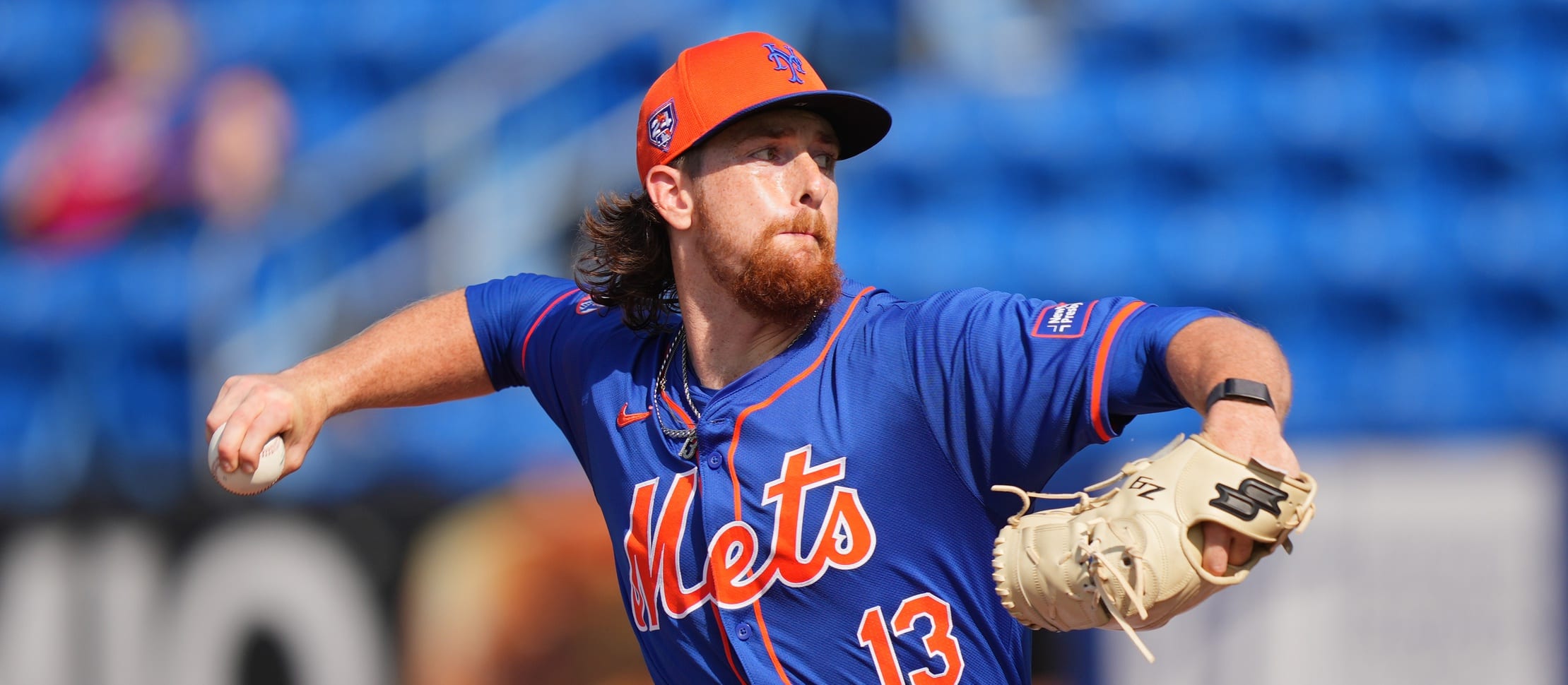
1. Nolan McLean, RHP, NYM, ADP: 99.3
McLean was always expected to end up a pitcher, but it's worth noting that 2025 was his first full season as a full-time pitcher, as he was getting reps as a two-way player as recently as early 2024. This helps explain why he has seemingly gotten better as he's climbed higher in pro ball, and that was most apparent when he dominated big-league hitters over 48 innings (21.8 K-BB%, 61.1 GB%) in even more impressive fashion than he did over 113.2 innings at Triple-A (16.4 K-BB%, 53.5 GB%). He throws six distinct pitches and has all the weapons
The top 400 prospect rankings are fully updated, as are the First-Year Player Draft rankings and the FYPD Blueprint. It's dynasty baseball season, but it's also heading into the heart of redraft fantasy baseball season, so I wanted to release an updated version of my top rookies to target in 2026 leagues.
I've noted each prospect's ADP from the last 15 NFBC Draft Champions leagues, and at the bottom of the article, there is a table showing where each prospect's ADP was through the first 12 Draft Champions vs. where it has been recently. I've marked UP or DOWN for prospects I'm higher or lower on than I was on version 1.0 and version 2.0 this offseason. I've also written the outlooks for hundreds of prospects, if you want a more in-depth breakdown of any of the players mentioned in this article.
1. Nolan McLean, RHP, NYM, ADP: 99.3
McLean was always expected to end up a pitcher, but it's worth noting that 2025 was his first full season as a full-time pitcher, as he was getting reps as a two-way player as recently as early 2024. This helps explain why he has seemingly gotten better as he's climbed higher in pro ball, and that was most apparent when he dominated big-league hitters over 48 innings (21.8 K-BB%, 61.1 GB%) in even more impressive fashion than he did over 113.2 innings at Triple-A (16.4 K-BB%, 53.5 GB%). He throws six distinct pitches and has all the weapons he needs against righties and lefties. The only question is how much to discount him for lacking a multi-year track record in the majors.
2. Bubba Chandler, RHP, PIT, ADP: 149
Chandler vs. Trey Yesavage is a toss-up, but I've moved Chandler slightly ahead, as has the average drafter. Chandler was getting drafted in high-stakes FAAB leagues last March and finished the year with six dominant starts in seven MLB outings. This feels like a classic breakout year for the 6-foot-3 righty, but you've got to pay up if you want him, as that's not an uncommon opinion. Chandler is all power all the time, sitting between 89 and 99 mph with his three offerings, which perhaps ups his risk of injury slightly, but he's been a relative workhorse entering his age-23 season. He can't be projected for double-digit wins, but he could hang with any other pre-prime starter in ratios and strikeouts.
3. Trey Yesavage, RHP, TOR, ADP: 151.9
Yesavage doesn't have the deepest arsenal or the best command of the rookie starting pitchers, but he's going to be a high-strikeout starter and is locked into a big-league rotation on a good team. He had a great minor-league season, but Yesavage wasn't considered in the same tier as these other top pitchers prior to his postseason dominance. The fact he doesn't turn 23 until after the 2026 All-Star break makes his long-term prospects all the more exciting. Eno Sarris noted on the Prospect Podcast this offseason that Yesavage has reverse splits, dominating lefties while being quite hittable against righties, which is worth considering when referencing his dominant postseason start against the Yankees and ability to neutralize Shohei Ohtani while also projecting ahead to what his ratios might look like over a full season. Just because that was an issue for Yesavage last season doesn't mean he can't make an adjustment for 2026, and it will be worth tracking his splits during spring training.
4. Konnor Griffin, SS, PIT, ADP: 198.1 UP
Even after all their offseason moves, Griffin projects as the Pirates' third-best position player, per ATC, behind Oneil Cruz and Brandon Lowe, and more importantly, I think it will be clear to everyone in spring training that he's one of the team's best players, and he'll obviously be a favorite to win NL Rookie of the Year. It makes sense for both sides to come to an agreement on a contract extension before Opening Day. If he is up all season, Griffin could hit 20 homers with 40 steals without hurting your batting average, and that type of realistic upside is almost never available this late. He was going around pick 300 early in draft season, and while the time to draft Griffin was during fantasy football season, he'll still pay off this current price tag if he's up for 130 games or so. Getting rid of short-season leagues and the pandemic make it difficult to compare past elite prospects to Griffin, but it's worth noting that Juan Soto (eight games at Double-A) Wander Franco (zero games at Double-A, 40 games at Triple-A), Michael Harris (43 games at Double-A) and Jackson Merrill (46 games at Double-A) were the closest comps I could find for if Griffin (21 games at Double-A) were to make the big club this spring.
5. Sal Stewart, 1B, CIN, ADP: 216.1
I've been highest on Stewart for the past couple years and I see no reason to back off now. He can handle first, second and third, but it's best to not worry too much about where he'll play or when he'll add another position of eligibility. Stewart is arguably the Reds' second-best hitter behind Elly De La Cruz -- ATC actually projects Stewart to be a better hitter (112 wRC+) than Elly (111 wRC+) this season -- so he'll be in the lineup almost every day, even if it's mostly designated hitter. Great American Ball Park will help the plus-hitting Stewart to maximize his above-average power, and he'll chip in over a half dozen steals while potentially leading rookie hitters in batting average. He's a high-end corner infielder and a low-end starting first baseman in 15-team leagues.
6. Samuel Basallo, C, BAL, ADP: 175.5
Basallo was the youngest hitter and arguably the best power hitter at Triple-A last year while also working on his catcher defense, so it needs to be understood that his power ceiling is very high as early as 2026. The fact that he only struck out 25.4 percent of the time in the majors right after turning 21 erases any concerns I would have had about him making enough contact in his first full MLB season. Baltimore is incentivized to play him enough for him to factor in the AL Rookie of the Year voting and he should deserve regular at-bats anyway, so I see a high floor and a 30-homer ceiling. I've often got both of my starting catchers before things get to Basallo in Draft Champions, but he's a nice source of power if you draft catchers in a more traditional manner.
7. Carter Jensen, C, KC, ADP: 203.6
Jensen isn't a long-touted prodigy like Basallo, but Jensen is only 14 months older than Basallo and was undoubtedly more productive over the final two months. He has been streaky at times in the minors, but he's clearly got plus power, good enough plate discipline and a sneaky chance to flirt with double-digit steals. I'm not worried at all about the playing time, as Jensen and Salvador Perez are pretty obviously two of the Royals' six best position players (along with Bobby Witt, Vinnie Pasquantino, Jac Caglianone and Maikel Garcia)
8. JJ Wetherholt, SS, STL, ADP: 273.9
Wetherholt is more floor than ceiling entering his rookie year, which is odd to say about a player with zero MLB experience. He should add third base eligibility shortly after Opening Day, which is a really nice bonus, so that he'll be eligible in the corner and middle spots. There are shades of Luke Keaschall and Matt Shaw with Wetherholt, where it's firmly hit-over-power in his early-20s and the hope is he steals 20-plus bases while playing every day and hitting for a good average. I don't see him struggling as much as Shaw did early, or excelling as much as Keaschall did early, but he should contribute a little bit of everything as a rookie.
9. Connelly Early, LHP, BOS, ADP: 227.7 DOWN
I said early in draft season that I couldn't picture myself jumping ADP on Early, even though I really like the player. He used to be going around pick 200, but I just got my first share at pick 281 -- after Wetherholt was off the board -- so I think you can throw out even the recent ADP I cited. At the end of the day, i still think Early will be in Boston's Opening Day rotation based on what he accomplished throughout 2025 and how he'll pitch this spring, but obviously his ADP should come down based on Boston's offseason moves, as it's objectively less likely now than it was at the beginning of the offseason that he will make the rotation. There are moments throughout the offseason when the price goes down on a player for something not related to their skills, and sometimes it looks like a great buying opportunity in hindsight. I think that's the moment we're currently in with Early, so while he's dipped, I think you should buy the dip.
10. Robby Snelling, LHP, MIA, ADP: 298.9 UP
Snelling surprisingly didn't make his big-league debut in September, instead continuing his onslaught of International League hitters. His development has been far from linear, as the Marlins had to rebuild him after acquiring him from San Diego in the 2024 Tanner Scott deadline deal, but he has never pitched better than he did at Triple-A last year (26 K-BB%, 47.9 GB%). Snelling has nothing left to prove in the minors, and the Marlins have a Prospect Promotion Incentive pick to chase, so they sent Edward Cabrera and Ryan Weathers north to give Snelling a clear runway this spring.
11. Kevin McGonigle, SS, DET, ADP: 303.7
Early in draft season the public preferred McGonigle slightly to Konnor Griffin, as McGonigle is the best pure hitter in the minors and almost two years older than Griffin, so he may have seemed like the more obvious candidate to be up early. As with Griffin, I think the incentives are in place for McGonigle to be on Detroit's Opening Day roster, but also like with Griffin, there's a chance he opens in the minors. If McGonigle were a consensus quality defender at shortstop, I'd be much more comfortable assuming he's on the Opening Day roster, but the majority of evaluators think he's destined for second base due to his arm, and Detroit only has a clear hole at shortstop. McGonigle's batting average is a big part of the long-term appeal -- he should contend for batting titles -- but it's possible he could play 135-plus games in the majors in 2026 and not clear 20 homers or 20 steals, so I'm less bullish on rolling the dice on McGonigle.
12. Logan Henderson, RHP, MIL, ADP: 285.9
Projections will always like Henderson more than scouts, as he's an undersized righty whose only notable pitch is a potentially 80-grade changeup and the 103 innings he logged in 2025 were actually a career high. The Brewers say he has a clean bill of health, but considering a flexor strain ended his season and he already had durability issues, I'm lower on Henderson for redraft than many. The Freddy Peralta trade clears a spot, but Brandon Sproat and Robert Gasser are overqualified to open the year in the Triple-A rotation, so there's still plenty of internal competition to stave off. I'll still take his rotation mate Chad Patrick, who is going three rounds later, straight up over Henderson.
13. Jonah Tong, RHP, NYM, ADP: 330.1 DOWN
The best pitcher in the minors last year and an unlucky pitcher in a short big-league sample, Tong is a very challenging player to value this offseason in redraft leagues. He relies mostly on his fastball and changeup and could conceivably open the year at Triple-A. He's more talented and has a higher ceiling than roughly half the Mets' projected rotation, but he'll have to win a job in camp. I'm sure there's some plan this offseason/spring to improve one of Tong's breaking balls, and he's a good breaking ball away from being a potential league-winner at this price.
14. Dylan Beavers, OF, BAL, ADP: 316.1
Beavers could get platooned or Colton Cowser could get platooned or they could both sit against a good chunk of lefties, and I think all those scenarios are realistic. However, the most likely scenario is that Beavers opens the year in a platoon while hitting in the bottom third of a good lineup. If he were to play regularly, Beavers could hit 15-20 homers and steal 20-plus bases with a decent batting average and a strong OBP. He's even got some sneaky higher-end potential outcomes as a player whose projectable 6-foot-5 frame has always hinted at more power potential than he's shown in games. It's not a given Jackson Holliday leads off all season against righties, but I think Cowser is more likely to supplant him than Beavers.
15. Bryce Eldridge, UT, SF, ADP: 393
The 6-foot-7 Eldridge will always have some swing and miss in his game, but he's been pushed very aggressively through the minors and had hard hit rates over 62 percent at Triple-A and the majors last year as a 20-year-old. Eldridge has 40-homer upside long term and logged groundball rates below 40 percent in 2024 and 2025. He would need to really struggle in spring training to not make the roster. The fact it'll take him at least a couple weeks to gain first base eligibility is something to consider as you're building your roster. He'll probably sit against a high percentage of lefties, at least early on.
16. Jacob Melton, OF, TB, ADP: 475 UP
When factoring in defense, I'm guessing Melton projects better for the Rays internally than Jake Fraley, Chandler Simpson and potentially Cedric Mullins. I'm not sure exactly how the platoons will shake out, but Melton should be on the Opening Day roster barring a poor spring. The lefty-hitting Melton is already 25 and will be under club control through his age-30 season, so the Rays get his entire prime, and they're not going to waste it at Triple-A. He doesn't need a robust playing time projection to get to 10 homers and 20 steals, and there's a real path to 500-plus plate appearances, which would allow him to reach 15 homers and 30 steals.
17. Carson Benge, OF, NYM, ADP: 367.9 UP
David Stearns has signaled that Benge has a track to a starting job, both by mentioning him by name earlier in the winter and by his offseason moves, which have left a clear spot for Benge alongside Juan Soto and Luis Robert. Stearns favorite Tyrone Taylor will play over Benge against lefties, and the rookie would likely hit in the bottom third of the lineup, even against righties. Still, like Dylan Beavers, Benge has a well-rounded enough game and enough breakout potential to still take a shot in the flyer range of drafts.
18. Payton Tolle, LHP, BOS, ADP: 384.8 DOWN
He's not getting drafted this way anymore, but I still think there's a slight chance Tolle is undeniable in the spring and forces his way into the Opening Day rotation. The reason he's dropped almost 100 spots in ADP is it's getting more and more likely that he's at Triple-A for over a month, even if he pitches perfectly fine in spring training. The ultimate bet on skills over roles pick this year is Tolle, as I'd value him next to Bubba Chandler and Trey Yesavage --- if I knew he'd make the rotation.
19. Elmer Rodriguez, RHP, NYY, ADP: 514.8 UP
Carlos Rodon (elbow) seems to be trending towards a return by late-April/early-May and Gerrit Cole (elbow) is tracking toward late-May/early-June, so mapping out Rodriguez's role throughout the 2026 season is a challenge. However, if we line up all the Yankees starters, only Max Fried is a better bet than Rodriguez to throw 150-plus innings in 2026. Rodriguez is already better than Will Warren and Luis Gil, and he's much more likely to be healthy in June than Ryan Weathers. So I'm not sure when Rodriguez will make starts in the majors this year, but I think he'll make over 15 starts and will be a valuable fantasy contributor whenever he's in the rotation. Rodriguez throws two distinct fastballs, two distinct sliders as well as a curveball and changeup. He had a 54.2 percent groundball rate and 19.6 K-BB% as a 21-year-old climbing from High-A to Triple-A this year, and his strike-throwing (8.2 BB% at Double-A) is a big separator relative to his peers.
20. Justin Crawford, OF, PHI, ADP: 299.5 UP
Crawford, whose ADP has climbed roughly 130 spots since the fist 12 Draft Champions, seems penciled into the Opening Day roster, but he's more expensive and less proven than some other speed-only outfielders, such as Victor Robles and Jake Mangum. He's essentially a discount version of Chandler Simpson, as both speedsters should sit against lefties and aren't guaranteed to reach 500 plate appearances.
21. Brandon Sproat, RHP, MIL, ADP: 505.7 UP
I'm higher on Sproat after writing his outlook, as he seemed to figure things out in the second half and he's always had good stuff. It's a perfect match with him going to Milwaukee -- they targeted Quinn Priester last offseason and we saw how that worked out. Brandon Woodruff and Logan Henderson are injury risks entering camp based on how their 2025 seasons ended, and Sproat should be no lower than seventh on the SP depth chart, and he could outperform Henderson and/or Robert Gasser this spring.
22. Aidan Miller, SS, PHI, ADP: 380.8 DOWN
Miller got off to a slow start last year after an aggressive assignment to Double-A as a 20-year-old. He rounded into form quickly, but the bigger story was that scouts were starting to throw out plus and even double-plus speed grades on Miller, whose speed was expected to be his least viable fantasy tool when he was drafted out of high school. From Memorial Day on, he had a .284 average, .425 OBP, 10 homers and 43 steals on 56 attempts in 77 games, with eight of those coming at Triple-A. The closer we get to Opening Day, the less likely it is for Alec Bohm to be dealt, and that seems to be Miller's one path to breaking camp with the big club. He has 15-20 homer, 30-steal upside as a rookie, but such playing time is not assured. Miller can play anywhere on the dirt, so he could also fill in if Trea Turner or Bryson Stott suffered an injury.
23. Colt Emerson, SS, SEA, ADP: 410.5
Even the redraft crowd seems to know that the 20-year-old Emerson's game isn't tailor made for standard roto, but he's still a phenom who could make waves in spring training and I believe he is clearly the short-term and long-term option at third base. He's too close to being ready for them to bring someone in ahead of him, so like with JJ Wetherholt and Aidan Miller, I'm betting Emerson is corner and middle eligible shortly after his big-league debut. Over Emerson's last 62 games, split between High-A, Double-A and Triple-A, he slashed .307/.403/.508 with a 17.7 K%, nine home runs and nine steals. There are shades here of Jackson Merrill in 2024, where everyone knew the hit tool was special but the game power and speed were TBD.
24. Joshua Baez, OF, STL, ADP: 455.8
Baez got top billing in my Rookies to Target article from a few months ago, and his ADP has climbed roughly 90 spots since then. It's not clear how aggressive the new regime will be at promoting prospects early in 2026, but Steamer projects a 26.8 K% for Baez, which would make him playable right away, given his power and defense. There's downside here, especially as the price climbs, because it's possible the new regime delays starting Baez's clock in favor of seeing what they have in their more tenuous outfielders.
25. Ryan Waldschmidt, OF, ARI, ADP: 470.5
Similarly to Baez, Waldschmidt could be an everyday power/speed OF, albeit with a little less upside in the speed department. Steamer gives Waldschmidt the same 104 wRC+ as Carter Jensen and has him just a tad behind JJ Wetherholt's 106 wRC projection. As things currently stand, the Diamondbacks could open the year with Alek Thomas and Blaze Alexander in starting outfield roles, so I could see Waldschmidt up as early as late-April or early-May, and as a righty who can play all three spots, he shouldn't have to come out of the lineup once he's up.
26. Moises Ballesteros, UT, CHC, ADP: 373.7
I'm still looking for a scout I trust to tell me Ballesteros has a chance to stick at catcher, but no luck so far. Even so, I came away from my deep dive higher than I expected to be on Ballesteros, both long term and short term. It's obviously all about the bat -- he's got a chance to be a DH and No. 5 hitter on a good playoff team someday. He's not as underpriced as Bryce Eldridge, but I don't mind drafting Ballesteros at his current price while assuming he'll clog my UT spot all year, and in the 5-10 percent chance he adds C eligibility, that would just be gravy.
27. Chase DeLauter, OF, CLE, ADP: 318.4
DeLauter has never played more than 57 games in a regular season, but his production has been as reliable as his fragility en route to making his big-league debut in the 2025 postseason. Lower-body injuries from before he was drafted in 2022 through the 2024 season have led to him no longer stealing bases, although his unavailability in 2025 was due to a sports hernia and broken hamate. Assuming he doesn't start running again (one steal in 70 games of full-season ball since 2024), DeLauter needs to be really productive at the dish, and we should assume he'll get hurt at some point. Give me lefty-hitting outfielders Dominic Canzone, Jesus Sanchez and Gavin Sheets, among others, who are all going at least a round later than DeLauter.
28. Andrew Painter, RHP, PHI, ADP: 358.5
Drafting Painter in this range is basically a blind bet on the 2022 version of Painter still being in there somewhere, as the 2025 version won't do us any good. It's not like his stuff was terrible, he just wasn't sharp or consistent from inning to inning, let alone start to start. He was basically as young and famous as you could be before getting TJS, so there's an argument that his body just needs more time to get back in sync. The one thing we know is the Phillies won't delay Painter's ascent to the big-league rotation if he's ready.
29. Parker Messick, LHP, CLE, ADP: 310.1
Messick is someone I used to think was very underrated in dynasty leagues, and now I think he's overrated in redraft leagues. I think he's better than Logan Allen, who still has a minor-league option remaining, but projection systems suggest a WHIP around 1.30 and under nine strikeouts per nine innings, so I don't think there's enough floor or ceiling to take him in this range.
30. Thomas White, LHP, MIA, ADP: 394.7
White's 2026 promotion should be one of the bigger in-season FAAB events. He's not close enough to being in the rotation to be draftable in March, given what we know now, but he's also too talented to spend more than a few months in the upper minors, as long as he's throwing enough strikes.
31. Carson Williams, SS, TB, ADP: 450.5
Williams could go 20/20 as early as this year, it's just a question of wether he'll make enough contact to stay in the lineup. He doesn't turn 23 until June, so he's still got time to right the ship, and Tampa Bay hasn't blocked him at shortstop.
32. Robert Gasser, LHP, MIL, ADP: 536.9 UP
Like with Sproat, Gasser shouldn't be slept on this spring, as there's no guarantee the top five on the SP depth chart in Milwaukee are all healthy at the end of spring training. He may not have a sky high ceiling, but I don't think he's much worse than fellow southpaws Noah Cameron or Ian Seymour on a per-start basis in 2026.
33. Owen Caissie, OF, MIA, ADP: 370.2
Caissie has an easier path to an Opening Day job after the trade to Miami, but even in a best-case scenario, he'll sit against southpaws and hit for a low-ish average. The Marlins have a lot of similarly talented options heading into 2026, so while Caissie will be given every opportunity to take a job and run with it, his hit tool is sketchy enough that he could be optioned to Triple-A in the first couple months.
34. Rhett Lowder, RHP, CIN, ADP: 532.8
Lowder's showing in the Arizona Fall League was encouraging after essentially a lost season in 2025. He's likely to open the year at Triple-A, but he should be the next man up whenever the Reds need to call on a starter.
35. Brice Matthews, 2B, HOU, ADP: 537
Similarly to Carson Williams, Matthews has big-time power/speed upside as early as this year, but unlike Williams, his team hasn't done him any favors with organizing the roster. Matthews probably needs an injury to play regularly in 2026.
36. Hunter Barco, LHP, PIT, ADP: 647.2
Even after trading Mike Burrows and Johan Oviedo, the Pirates still have enough pitching depth to send Barco to Triple-A to start the year. Barco is a big-league ready No. 4/5 starter, and as a southpaw, there's a chance he surprises and does a little better than that.
37. Joe Mack, C, MIA, ADP: 433.9
Mack is clearly the Marlins' catcher of the future, but he's been pushed pretty aggressively and is always going to be power over hit. I don't expect him to hit for a solid batting average as a rookie, but he should play a lot over the final four months or so.
38. Abimelec Ortiz, 1B, WAS, ADP: 700.6 UP
I was warming up to the idea of drafting Ortiz as a third or fourth first baseman in DCs before he was traded from Texas, and now he's got an even clearer path to playing time. Ortiz could potentially sit against lefties, but I think he could hit around .240 with 20 homers if he were to make the team out of camp.
39. Tanner McDougal, RHP, CHW, ADP: 678.9
One of my favorite sleepers within the top 100, McDougal mastered Double-A last year as a 22-year-old, and he might not need more than half a dozen starts at Triple-A before he's ready for primetime. His command is the separator for him vs. org. mates Hagen Smith (CHW) and Noah Schultz (CHW).
40. Jaxon Wiggins, RHP, CHC, ADP: 646.8
The acquisition of Edward Cabrera means one more starter ahead of Wiggins on the depth chart, and Justin Steele (elbow) should be back around May, so Wiggins could spend a few months at Triple-A. Still, he's got a very high ceiling, particularly with strikeouts, and it's not a workhorse-heavy rotation, per say, so Wiggins will likely be heard from sometime this summer.
41. George Klassen, RHP, LAA, ADP: 691.3 UP
Klassen was excellent to close 2025 and is in the right organization to get an opportunity early in 2026. He has always had some of the best stuff in the minors with very suspect command, but the command seems to be trending in the right direction.
42. Zach Cole, OF, HOU, ADP: 485.9
Every projection system has Cole for a batting average below .220, which obviously isn't palatable in fantasy and probably won't be palatable for the Astros if it plays out like that. He's no less risky than guys like Spencer Jones (NYY) or Junior Perez (ATH), but the fact Cole has shown off his tools in the majors is why he's the one getting drafted so high.
43. Kemp Alderman, OF, MIA, ADP: 749.4 UP
I believe in Alderman eventually being a productive fantasy outfielder more than I believe in Owen Caissie, but I also recognize Caissie will get the opportunity before Alderman. Even so, if Alderman is as good as he was last year at Triple-A (160 wRC+ in 20 games), Miami will find room for him somewhere this summer.
44. Kade Anderson, LHP, SEA, ADP: 685.6
If you're looking for a prospect from the most recent draft class to rocket to the majors and make an impact this summer, Anderson is the best bet, followed by three other pitchers, Jamie Arnold (ATH), Tyler Bremner (LAA) and Liam Doyle (STL). The Mariners might turn to Logan Evans or Emerson Hancock if there's a rotation need early in 2026, but Anderson shouldn't need more than a couple months to pass those guys on the organizational depth chart.
45. Jack Wenninger, RHP, NYM, ADP: 746.6 UP
Wenninger may be the prospect who won me over most when I was writing his outlook for 2026. Not only is his floor very high, but I think his ceiling is higher than people realize. He's got a full pitch mix, highlighted by multiple plus fastballs and a plus-plus splitter, and he was dominant to close 2025. The Mets have plenty of rotation depth, but Wenninger is a solid skills bet for the second half.
46. Brody Hopkins, RHP, TB, ADP: 700.5
Like Thomas White (MIA), Hopkins has FAAB-a-palooza potential in-season if things come together for him this year at Triple-A. He has the look of a powerful No. 2 starter, as long as he can throw enough strikes.
47. Jett Williams, SS, MIL, ADP: 591.5 UP
Williams obviously wasn't going to supplant Francisco Lindor or Marcus Semien in New York, and he's a classic Brewers position player, so the trade is a good outcome for those rostering him in redraft and dynasty. It might take a few months for Williams to get the call, but if he's making good swing decisions at Triple-A while Joey Ortiz struggles for a second year in a row, you could see the Brewers make that move early.
48. Trey Gibson, RHP, BAL, ADP: 653.3
The Orioles loaded up this offseason, but if they need a pitching prospect to join the rotation midseason, Gibson should get the call. He's got a high strikeout ceiling as a rookie but there will probably be some growing pains as well.
49. Emmanuel Rodriguez, OF, MIN, ADP: 618.1
Rodriguez's injury history is up there with Chase DeLauter's (CLE), but Rodriguez doesn't have the clear path to an Opening Day job that DeLauter does. Rodriguez is at least on the 40-man roster, so I think he'd get the call over Walker Jenkins (MIN) if they're both performing early in 2026 and the Twins have a need.
50. Walker Jenkins, OF, MIN, ADP: 509.7
If I were running the Twins, I'd go into the year with the assumption that I'd be calling up Jenkins in late-August to preserve his rookie eligibility for 2027, but I'd be open to him forcing my hand earlier than that, especially if the team is contending for the division and there's an opening in the outfield. The Twins have 11 outfielders on the 40-man roster, and Jenkins isn't one of them, so I just don't see him being up early, given that he hasn't mastered Triple-A and has missed so much time due to injuries.
HONORABLE MENTION:
Ethan Pecko, RHP, HOU, ADP: 707.5
Blade Tidwell, RHP, SF, ADP: 738.6
Harry Ford, C, WAS, ADP: 393.5
George Valera, OF, CLE, ADP: 614.7
JR Ritchie, RHP, ATL, ADP: 635.1
Jhostynxon Garcia, OF, PIT, ADP: 557
Nelson Rada, OF, LAA, ADP: 675.6
Hagen Smith, LHP, CHW, ADP: 713.5
Connor Prielipp, LHP, MIN, ADP: 731.4
River Ryan, RHP, LAD, ADP: 586.9
Jose Corniell, RHP, TEX, ADP: 746
AJ Blubaugh, RHP, HOU, ADP: 552.7
Trevor McDonald, RHP, SF, ADP: 589.1
Top 50 Rookies For 2026 Fantasy Baseball Leagues
| Prospect | Position | Team | October ADP | January ADP | |
| 1 | Nolan McLean | SP | NYM | 108.2 | 99.3 |
| 2 | Bubba Chandler | SP | PIT | 156.4 | 149 |
| 3 | Trey Yesavage | SP | TOR | 146.7 | 151.9 |
| 4 | Konnor Griffin | SS | PIT | 288.1 | 198.1 |
| 5 | Sal Stewart | 1B | CIN | 247.3 | 216.1 |
| 6 | Samuel Basallo | C | BAL | 177.3 | 175.5 |
| 7 | Carter Jensen | C | KC | 238.6 | 203.6 |
| 8 | JJ Wetherholt | SS | STL | 261 | 273.9 |
| 9 | Connelly Early | SP | BOS | 203.3 | 227.7 |
| 10 | Robby Snelling | SP | MIA | 369.3 | 298.9 |
| 11 | Kevin McGonigle | SS | DET | 269.3 | 303.7 |
| 12 | Logan Henderson | SP | MIL | 310.2 | 285.9 |
| 13 | Jonah Tong | SP | NYM | 260.3 | 330.1 |
| 14 | Dylan Beavers | OF | BAL | 283.9 | 316.1 |
| 15 | Bryce Eldridge | UT | SF | 352 | 393 |
| 16 | Jacob Melton | OF | TB | 640.2 | 475 |
| 17 | Carson Benge | OF | NYM | 537.8 | 367.9 |
| 18 | Payton Tolle | SP | BOS | 301.5 | 384.8 |
| 19 | Elmer Rodriguez | SP | NYY | 533.6 | 514.8 |
| 20 | Justin Crawford | OF | PHI | 429.3 | 299.5 |
| 21 | Brandon Sproat | SP | MIL | 426.5 | 505.7 |
| 22 | Aidan Miller | SS | PHI | 402.9 | 380.8 |
| 23 | Colt Emerson | SS | SEA | 462.3 | 410.5 |
| 24 | Joshua Baez | OF | STL | 544.3 | 455.8 |
| 25 | Ryan Waldschmidt | OF | ARI | 654.8 | 470.5 |
| 26 | Moises Ballesteros | UT | CHC | 353.6 | 373.7 |
| 27 | Chase DeLauter | OF | CLE | 319.9 | 318.4 |
| 28 | Andrew Painter | SP | PHI | 357 | 358.5 |
| 29 | Parker Messick | SP | CLE | 278.7 | 310.1 |
| 30 | Thomas White | SP | MIA | 449.8 | 394.7 |
| 31 | Carson Williams | SS | TB | 432.7 | 450.5 |
| 32 | Robert Gasser | SP | MIL | 572 | 536.9 |
| 33 | Owen Caissie | OF | MIA | 470 | 370.2 |
| 34 | Rhett Lowder | SP | CIN | 484 | 532.8 |
| 35 | Brice Matthews | 2B | HOU | 496.5 | 537 |
| 36 | Hunter Barco | SP | PIT | 645.8 | 647.2 |
| 37 | Joe Mack | C | MIA | 494.5 | 433.9 |
| 38 | Abimelec Ortiz | 1B | WAS | 712.1 | 700.6 |
| 39 | Tanner McDougal | SP | CHW | 721.3 | 678.9 |
| 40 | Jaxon Wiggins | SP | CHC | 592.5 | 646.8 |
| 41 | George Klassen | SP | LAA | 645.1 | 691.3 |
| 42 | Zach Cole | OF | HOU | 433.2 | 485.9 |
| 43 | Kemp Alderman | OF | MIA | 728.8 | 749.4 |
| 44 | Kade Anderson | SP | SEA | 639.4 | 685.6 |
| 45 | Jack Wenninger | SP | NYM | N/A | 746.6 |
| 46 | Brody Hopkins | SP | TB | 682.4 | 700.5 |
| 47 | Jett Williams | SS | MIL | 535.8 | 591.5 |
| 48 | Trey Gibson | SP | BAL | 598.4 | 653.3 |
| 49 | Emmanuel Rodriguez | OF | MIN | 545.5 | 618.1 |
| 50 | Walker Jenkins | OF | MIN | 452.5 | 509.7 |
| Blade Tidwell | SP | SF | 732 | 738.6 | |
| Harry Ford | C | WAS | 542 | 393.5 | |
| George Valera | UT | CLE | 588.4 | 614.7 | |
| Ethan Pecko | SP | HOU | 697.6 | 707.5 | |
| JR Ritchie | SP | ATL | 597.7 | 635.1 | |
| Jhostynxon Garcia | OF | PIT | 693.2 | 557 | |
| Nelson Rada | OF | LAA | 700.8 | 675.6 | |
| Hagen Smith | SP | CHW | 711.6 | 713.5 | |
| Connor Prielipp | SP | MIN | 723.9 | 731.4 | |
| River Ryan | SP | LAD | 631.8 | 586.9 | |
| Jose Corniell | SP | TEX | 726.8 | 746 | |
| AJ Blubaugh | SP | HOU | 477.6 | 552.7 | |
| Trevor McDonald | SP | SF | 527.9 | 589.1 |